
What Is the Best Magnesium Supplement? (Expert Guide to Types, Benefits & Safety)
Micronutrient & Nervous System Health Guide | Evidence-Based Nutrition – Top Health Coach
Educational content reviewed using current nutrition science and clinical practice insights
The best magnesium supplement depends on your health goal, but for most people, Magnesium Glycinate is the best overall choice due to its high absorption, gentle effect on digestion, and benefits for sleep, stress, and muscle relaxation. Other forms like Magnesium Citrate, Malate, and Threonate may be better for specific needs such as digestion, energy, or brain health.
👉 There is no single “best” magnesium for everyone—the best supplement is the one that matches your body’s needs.
Why Magnesium Matters More Than Ever
Magnesium deficiency is extremely common due to:
- Processed food diets
- Chronic stress
- Poor sleep
- Excess caffeine and alcohol
- Certain medications
Low magnesium levels are linked to:
- Muscle cramps
- Fatigue
- Poor sleep
- Anxiety and stress
- Headaches
- Blood sugar imbalance
Yet many people take the wrong form of magnesium and see no benefit.
What Does Magnesium Do in the Body?
Magnesium is involved in 300+ biochemical reactions, supporting:
- Muscle and nerve function
- Heart rhythm
- Energy production
- Blood sugar control
- Bone health
- Nervous system regulation
- Sleep quality
Without enough magnesium, the body struggles to relax and recover.
Why the Type of Magnesium Matters
Magnesium supplements are bound to different compounds, which affect:
- Absorption
- Digestive tolerance
- Target benefits
❌ Taking the wrong type can cause diarrhea or no noticeable effect.
✔ Taking the right type improves results dramatically.
Best Types of Magnesium Supplements (Ranked by Use)
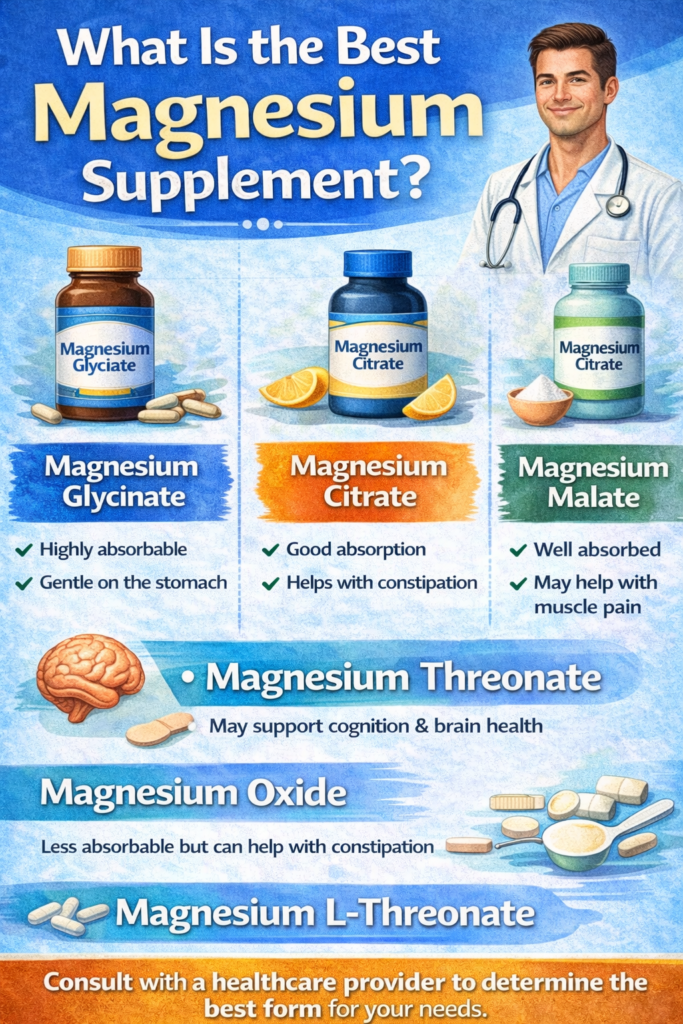
1. Magnesium Glycinate – Best Overall Choice
Best for: Sleep, anxiety, stress, muscle cramps
Absorption: Excellent
Digestive tolerance: Very gentle
Why It’s the Top Choice
- Highly bioavailable
- Rarely causes diarrhea
- Calming effect on the nervous system
👉 Ideal for people with stress, insomnia, muscle tension, or anxiety.
2. Magnesium Citrate – Best for Digestion
Best for: Constipation, digestion
Absorption: Good
Digestive tolerance: Can cause loose stools
Good to Know
- Works well for short-term use
- Not ideal for daily long-term use if digestion is sensitive
3. Magnesium Malate – Best for Energy & Fatigue
Best for: Low energy, muscle soreness
Absorption: Good
Why It Helps
- Supports ATP (energy) production
- Often used for chronic fatigue or muscle pain
4. Magnesium Threonate – Best for Brain Health
Best for: Focus, memory, cognitive support
Absorption: Excellent (crosses blood-brain barrier)
Important Note
- More expensive
- Lower elemental magnesium per dose
5. Magnesium Taurate – Best for Heart Health
Best for: Blood pressure, heart rhythm
Absorption: Good
Supports cardiovascular and nervous system balance.
Magnesium Forms to Be Cautious With
Magnesium Oxide
❌ Poor absorption
❌ More likely to cause digestive upset
Often included in cheap supplements—generally not recommended.
How to Choose the Best Magnesium Supplement for YOU
| Your Goal | Best Magnesium Type |
|---|---|
| Better sleep | Magnesium Glycinate |
| Stress/anxiety | Magnesium Glycinate |
| Constipation | Magnesium Citrate |
| Low energy | Magnesium Malate |
| Brain health | Magnesium Threonate |
| Heart health | Magnesium Taurate |
Best Time to Take Magnesium
- Evening or before bed → for sleep and relaxation
- Morning → for energy-focused forms like Malate
Magnesium can be taken with or without food, depending on tolerance.
Recommended Dosage (General Guidance)
- Typical range: 200–400 mg/day
- Start low and increase gradually
⚠ Always personalize dosage with a healthcare professional.
Magnesium from Food vs Supplements
Magnesium-Rich Foods
- Leafy greens
- Nuts & seeds
- Legumes
- Whole grains
While food is ideal, many people still fall short—supplements help fill the gap, not replace food.
Who Should Be Careful with Magnesium Supplements
Consult a healthcare professional if you have:
- Kidney disease
- Heart conditions
- Are on diuretics or heart medications
Common Mistakes People Make
❌ Choosing the cheapest magnesium
❌ Taking too much too fast
❌ Ignoring digestive reactions
❌ Expecting instant results
Benefits usually appear within 1–3 weeks.
E-E-A-T Credibility Statement
This article is based on:
- Evidence-based nutrition science
- Clinical supplement research
- Real-world health coaching experience
Educational purpose only. Not a substitute for medical advice.
Frequently Asked Questions (FAQ)
1. What is the best magnesium supplement overall?
Magnesium Glycinate for most people.
2. Which magnesium is best for sleep?
Magnesium Glycinate.
3. Which magnesium is best for constipation?
Magnesium Citrate (short-term).
4. Is magnesium safe to take daily?
Yes, within recommended doses.
5. How long does magnesium take to work?
Usually 1–3 weeks.
6. Can magnesium help anxiety?
Yes, especially Glycinate.
7. Can I take magnesium with Vitamin D?
Yes—and it often improves Vitamin D effectiveness.
8. Is food magnesium enough?
Often not, due to modern diets.
9. Should I take magnesium at night?
Yes, if using it for relaxation or sleep.
10. Is more magnesium better?
No. More is not always better.
Final Takeaway: The Best Magnesium Is the Right One for Your Body
There is no universal “best” magnesium—but there is a best choice for your goal.
For most people, Magnesium Glycinate offers the best balance of absorption, safety, and benefits.