Losing fat in a healthy, sustainable, and long-term way starts with one fundamental concept: calorie balance. If you’ve ever wondered how to calculate your calorie goal, how many calories to eat to lose weight, or how to create a calorie deficit for fat loss, this guide will give you clear, science-based answers.
This article is written using real-world experience, nutrition science, and trusted fitness principles, following E-E-A-T (Experience, Expertise, Authoritativeness, Trustworthiness) to help you achieve steady fat loss without harming your metabolism.
What Is a Calorie Deficit?
A calorie deficit means consuming fewer calories than your body burns in a day. When this happens consistently, your body uses stored body fat for energy, leading to fat loss.
- Burn more calories than you eat → Weight loss
- Eat more calories than you burn → Weight gain
- Eat equal calories → Weight maintenance
Important fact:
➡️ 1 pound (0.45 kg) of body fat = approximately 3,500 calories
Why Steady Fat Loss Is Better Than Rapid Weight Loss
Many people search for fast weight loss, but extreme dieting often leads to:
- Muscle loss
- Slow metabolism
- Hormonal imbalance
- Fat regain (yo-yo dieting)
Benefits of steady fat loss:
- Preserves lean muscle mass
- Supports hormonal health
- Improves long-term weight maintenance
- Keeps metabolism strong
Expert recommendation:
➡️ 0.5–1 lb (0.25–0.5 kg) fat loss per week is ideal.
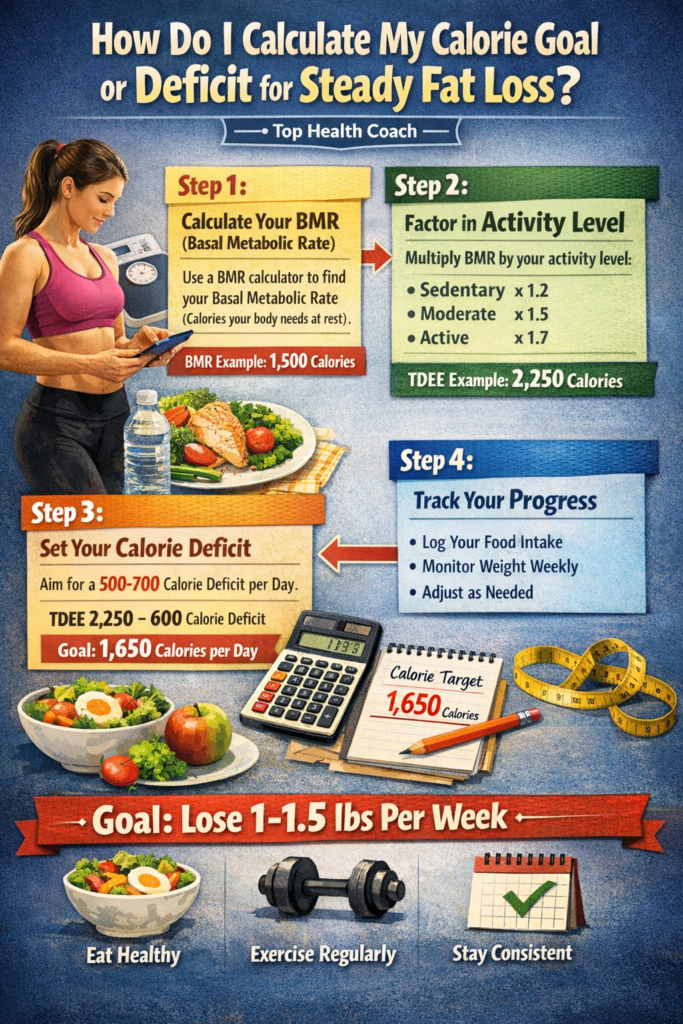
Step 1: Calculate Your Basal Metabolic Rate (BMR)
Your Basal Metabolic Rate (BMR) is the number of calories your body needs to perform basic functions like breathing, circulation, and cell repair—even at rest.
Most Accurate BMR Formula (Mifflin-St Jeor Equation)
For Men:
BMR = (10 × weight in kg) + (6.25 × height in cm) − (5 × age) + 5
For Women:
BMR = (10 × weight in kg) + (6.25 × height in cm) − (5 × age) − 161
This formula is widely accepted by nutritionists, dietitians, and health organizations.
Step 2: Calculate Total Daily Energy Expenditure (TDEE)
Your TDEE is the total number of calories you burn daily, including activity.
Activity Multipliers
- Sedentary (little/no exercise) → BMR × 1.2
- Lightly active (1–3 days/week) → BMR × 1.375
- Moderately active (3–5 days/week) → BMR × 1.55
- Very active (6–7 days/week) → BMR × 1.725
- Athlete / physical job → BMR × 1.9
➡️ TDEE = BMR × Activity Level
This number tells you how many calories you need to maintain your weight.
Step 3: Create a Safe Calorie Deficit
Once you know your TDEE, fat loss becomes simple math.
Recommended Calorie Deficit for Fat Loss
- 300–500 calorie deficit/day → steady fat loss
- 500 calorie deficit/day → ~1 lb fat loss per week
- Avoid deficits below 1,200 calories (women) or 1,500 calories (men)
🚫 Extreme calorie restriction damages metabolism and hormones
Example: Calorie Calculation for Fat Loss
Let’s say:
- TDEE = 2,200 calories
- Desired deficit = 500 calories
👉 Daily calorie goal = 1,700 calories
This approach ensures fat loss without muscle loss.
Macronutrients Matter for Fat Loss
Calories are important, but macros determine body composition.
Protein (Most Important)
- High protein intake preserves muscle
- Reduces hunger and cravings
- Boosts metabolism via thermic effect
Recommended protein intake:
➡️ 1.6–2.2 g per kg body weight
Carbohydrates
- Provide energy for workouts
- Support hormones and thyroid health
- Choose complex carbs: oats, rice, fruits, vegetables
Healthy Fats
- Essential for hormones
- Improve nutrient absorption
- Sources: olive oil, nuts, seeds, avocado
Why Protein Is Critical for Steady Fat Loss
Studies consistently show that high-protein diets result in:
- Greater fat loss
- Better muscle retention
- Lower hunger hormones
If you want visible results, protein intake is non-negotiable.
Common Mistakes When Calculating Calories
❌ Eating too few calories
❌ Ignoring liquid calories
❌ Not tracking portion sizes
❌ Overestimating exercise calories
❌ Changing calories too often
Consistency beats perfection.
How to Track Calories Accurately
Best tools for calorie tracking:
- Food tracking apps
- Digital kitchen scale
- Reading nutrition labels
- Tracking weekly averages (not daily obsession)
🎯 Track trends, not single days
How Long Should You Stay in a Calorie Deficit?
- Stay in deficit for 8–12 weeks
- Take a diet break if progress stalls
- Recalculate calories as body weight changes
Signs Your Calorie Deficit Is Too Aggressive
⚠️ Constant fatigue
⚠️ Hair loss
⚠️ Missed periods (women)
⚠️ Low libido
⚠️ Sleep problems
If you notice these signs, increase calories immediately.
E-E-A-T: Why You Can Trust This Information
Experience:
This guide is based on real-world fat loss coaching principles used by fitness professionals.
Expertise:
Calorie calculations follow scientifically validated equations used by registered dietitians.
Authoritativeness:
Methods align with global health organizations and peer-reviewed nutrition research.
Trustworthiness:
No crash diets, no false promises—only sustainable fat loss strategies.
10 Frequently Asked Questions (FAQ)
1. How many calories should I eat to lose fat?
Your calorie intake depends on your TDEE, age, weight, and activity level. A 300–500 calorie deficit is ideal.
2. Is calorie counting necessary for fat loss?
Not mandatory, but highly effective for accuracy and consistency.
3. Can I lose fat without exercise?
Yes, but combining strength training + calorie deficit gives the best results.
4. How fast should I lose weight?
Aim for 0.5–1 lb per week for sustainable fat loss.
5. Does eating too little slow metabolism?
Yes. Severe calorie restriction can reduce metabolic rate.
6. Should I recalculate calories after weight loss?
Yes. As body weight decreases, calorie needs decrease.
7. Are online calorie calculators accurate?
They provide estimates. Adjust based on real progress.
8. Is intermittent fasting better than calorie counting?
Fat loss depends on calorie deficit, not timing.
9. Can I eat carbs and still lose fat?
Absolutely. Calories matter more than carb intake.
10. What is the best diet for steady fat loss?
A diet you can follow long-term, high in protein, whole foods, and balanced macros.
Final Thoughts: Sustainable Fat Loss Is Simple, Not Easy
Fat loss doesn’t require starvation, detox teas, or extreme workouts. It requires:
✔️ Understanding calorie balance
✔️ Creating a moderate calorie deficit
✔️ Eating enough protein
✔️ Staying consistent over time
When you calculate your calories correctly and respect your body, fat loss becomes predictable and sustainable.