The human hip exercise is a complex ball-and-socket joint () designed to provide both significant weight-bearing stability and a wide range of multi-axial mobility. Maintaining the health of this joint requires a balanced approach to strengthening the primary movers—the gluteals, hamstrings, and quadriceps—while ensuring flexibility in the hip flexors and adductors. Weakness in the hip musculature, particularly the abductors, is a primary contributor to lower-body instability, gait abnormalities, and referred pain in the lower back and knees.
Functional Anatomy of the Hip
To effectively train the hips, one must understand the three-dimensional movement patterns of the joint. The hip performs flexion, extension, abduction (moving away from the midline), adduction (moving toward the midline), and internal/external rotation. The primary muscles involved include:
- Gluteus Maximus: The largest muscle in the body and the primary hip extensor.
- Gluteus Medius and Minimus: Located on the lateral aspect of the hip, these are the primary abductors and stabilizers of the pelvis during single-leg movements.
- Iliopsoas: The strongest of the hip flexors, originating from the lumbar spine and pelvis.[
- Adductor Group: Muscles on the inner thigh that pull the legs together and assist in stabilization.
- Deep Rotators: Including the piriformis, these muscles manage the orientation of the femoral head within the acetabulum.
Essential Strengthening Exercises
Strengthening should focus on “functional” movements that mimic daily activities or athletic requirements.
1. The Squat (Traditional and Sumo) The squat is considered a fundamental “compound” movement. Research indicates it provides some of the highest levels of activation for the gluteus maximus and quadriceps.
- Execution: Stand with feet shoulder-width apart. Hinge at the hips workout and bend the knees as if sitting in a chair, keeping the chest upright.
- Sumo Variation: A wider stance with toes pointed outward increases the demand on the hip adductors.
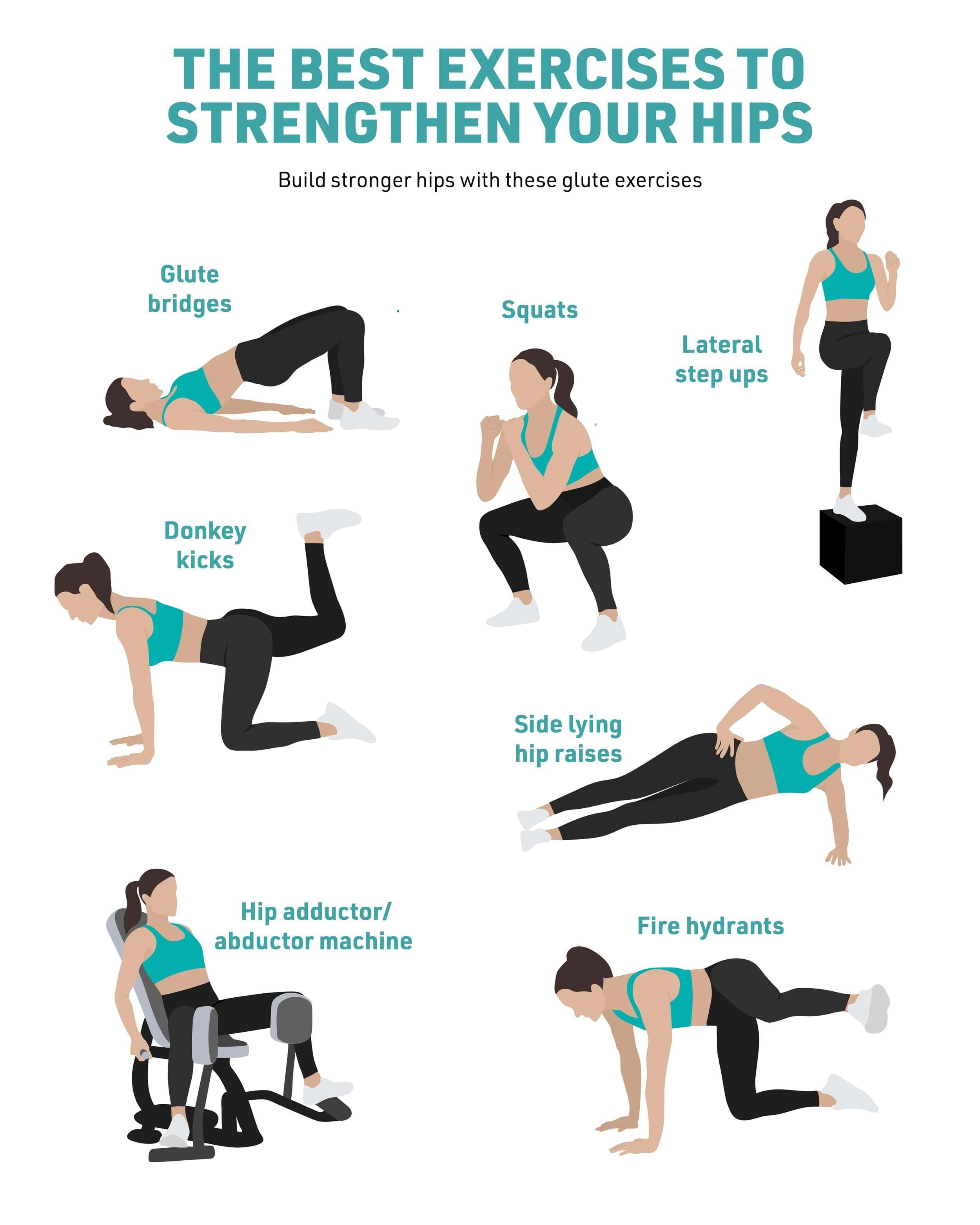
2. Hip Bridges (Single and Double Leg) Bridges isolate the posterior chain while minimizing stress on the lower back.
- Execution: Lie on your back with knees bent and feet flat. Lift the pelvis toward the ceiling by squeezing the glutes.
- Progression: The single-leg bridge increases intensity and challenges pelvic stability, which is vital for runners and athletes.
3. Lateral Band Walks (Monster Walks) This exercise specifically targets the gluteus medius, a muscle often neglected in forward-moving activities like walking or running.
- Execution: Place a resistance band above the knees or ankles. Maintain a “mini-squat” position and take controlled steps to the side, ensuring the knees do not cave inward.
4. Clamshells Clamshells are a staple in physical therapy for activating the external rotators and abductors.
- Execution: Lie on your side with knees bent at 45 degrees. Keeping the feet together, lift the top knee as high as possible without rotating the pelvis backward.
5. Romanian Deadlifts (RDLs) RDLs focus on hip hinging and eccentric strength of the hamstrings and glutes.
- Execution: Stand with a slight bend in the knees. Hinge forward at the hips while keeping the spine neutral, lowering weights along the shins until a stretch is felt in the hamstrings.
Flexibility and Mobility Drills
Strength without mobility leads to joint stiffness and increased injury risk. The following stretches help maintain the joint’s full range of motion.
- Figure-Four Stretch: Lie on your back and cross one ankle over the opposite knee. Pull the bottom thigh toward the chest to stretch the deep rotators (piriformis)
- Half-Kneeling Hip Flexor Stretch: Kneel on one knee with the other foot forward. Tuck the pelvis under and shift weight forward slightly to stretch the iliopsoas.
- Butterfly Pose: Sit with the soles of the feet together and knees dropped to the sides. This targets the adductors and improves blood circulation to the pelvic region.
Considerations for Special Populations
For older adults or those with osteoarthritis, high-impact movements should be avoided. Instead, focus on “closed-chain” exercises like sit-to-stands and seated knee raises to improve functional independence. Conversely, athletes should incorporate “dynamic” warm-ups, such as Frankenstein walks and hip circles, to prepare the joint for explosive movements.
Training Frequency and Safety
For general health, hip conditioning should be performed 2 to 3 days per week. It is essential to avoid “compensatory movements,” such as arching the lower back during hip extensions, which can lead to lumbar strain. If sharp pain occurs during any movement, the exercise should be discontinued immediately, and a medical professional should be consulted.
So, What Is the Best Exercise for Hips?
If we had to choose one movement that activates most hip muscles effectively, the answer would be:
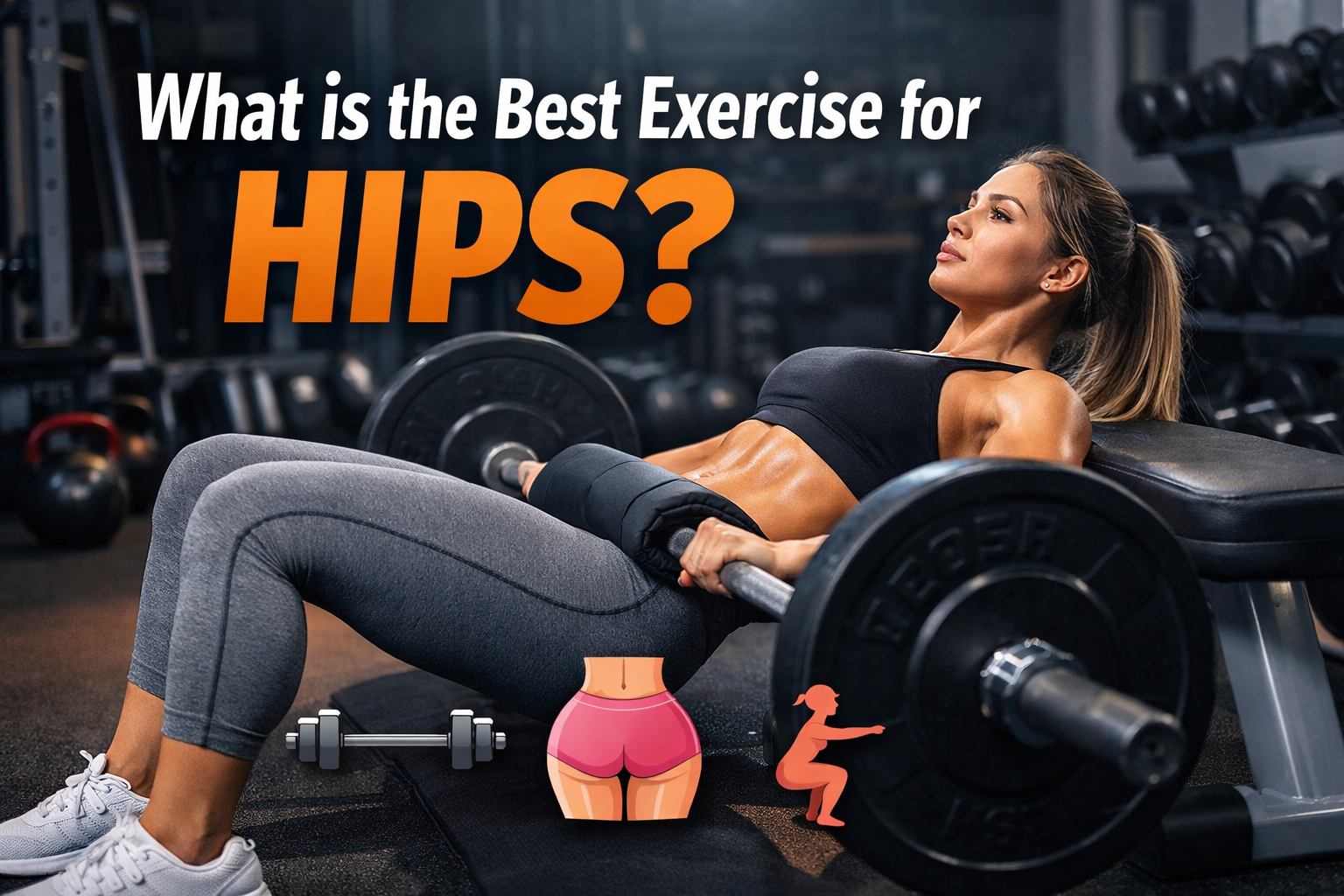
🏆 Barbell Hip Thrust
The Barbell Hip Thrust is widely considered the most effective hip exercise because it directly targets the gluteus maximus while also engaging the hamstrings and core.
Why It’s So Effective:
- High glute activation
- Builds size and strength
- Improves athletic performance
- Supports lower back health
How to Perform a Hip Thrust:
- Sit on the floor with your upper back against a bench.
- Roll a barbell over your hips.
- Bend your knees and plant your feet flat.
- Drive through your heels and lift your hips upward.
- Squeeze your glutes at the top.
- Lower slowly and repeat.
This movement is one of the top glute building exercises for both beginners and advanced lifters.
Other Best Exercises for Hips
While the Hip Thrust is powerful, a balanced routine gives better results.
1. Squats
The Squat is a foundational lower body exercise that builds overall strength.
Benefits:
- Engages glutes, quads, and hamstrings
- Improves hip mobility
- Boosts muscle growth
Variations include:
- Sumo Squats
- Goblet Squats
- Barbell Back Squats
2. Bulgarian Split Squats
This single-leg movement improves balance and targets the hips intensely.
Why it works:
- Activates gluteus medius
- Enhances muscle symmetry
- Builds strength and stability
3. Romanian Deadlifts (RDLs)
The Romanian Deadlift strengthens the posterior chain.
Benefits:
- Stretches and activates glutes
- Builds hip power
- Improves posture
4. Cable Kickbacks
If your goal is shaping and isolating, Cable Glute Kickbacks are excellent.
They:
- Target gluteus maximus
- Improve muscle definition
- Help in toning hips fast
5. Clamshells
For beginners or rehabilitation, Clamshell Exercises activate the outer hips.
They:
- Strengthen hip abductors
- Prevent knee pain
- Improve hip stability
How Can I Build My Hips Fast?
Building hips quickly requires a smart combination of:
1. Progressive Overload
Gradually increase weight, reps, or intensity.
2. Strength Training 2–3 Times Per Week
Train hips consistently without overtraining.
3. High-Protein Diet
Muscle growth depends on nutrition.
4. Compound Movements
Focus on Hip Thrusts, Squats, and Deadlifts.
5. Adequate Rest
Muscles grow during recovery, not during workouts.
If you stay consistent with heavy glute focused workouts, visible changes can begin within 4–8 weeks.
How Can I Tone My Hips Fast?
Toning means reducing fat while improving muscle definition.
To tone hips fast:
- Combine strength training with cardio workouts
- Maintain a slight calorie deficit
- Do higher rep sets (12–15 reps)
- Add resistance bands
- Focus on controlled movement
Remember, spot reduction is a myth. Fat loss happens overall, but targeted training shapes the muscles underneath.
Is It Good to Workout Hips?
Yes — absolutely.
Training hips provides benefits beyond appearance:
- Improves posture
- Reduces lower back pain
- Enhances athletic performance
- Prevents knee injuries
- Supports pelvic stability
Strong hips are essential for long-term mobility and joint health.
Can You Shape Your Hips?
Yes, but within your genetic structure.
You cannot change bone structure, but you can:
- Increase muscle size
- Improve muscle tone
- Enhance symmetry
- Reduce fat around the area
Through consistent hip shaping exercises, you can create a fuller, stronger appearance.
Sample Weekly Hip Workout Plan
Day 1 – Strength Focus
- Barbell Hip Thrust – 4 sets of 8
- Romanian Deadlift – 3 sets of 10
- Bulgarian Split Squat – 3 sets each leg
- Cable Kickbacks – 3 sets of 12
Day 2 – Toning & Activation
- Bodyweight Squats – 3 sets of 15
- Glute Bridges – 3 sets of 20
- Clamshells – 3 sets of 15
- Resistance Band Walks – 3 rounds
Common Mistakes in Hip Workouts
- Skipping warm-up
- Lifting too heavy too soon
- Ignoring mind-muscle connection
- Not training consistently
- Poor nutrition
Avoiding these improves results significantly.
Nutrition for Hip Muscle Growth
To maximize hip muscle development, prioritize:
- Lean protein (eggs, chicken, tofu)
- Complex carbs (oats, rice)
- Healthy fats (nuts, seeds)
- Hydration
Muscle cannot grow without proper fuel.
10 Frequently Asked Questions (FAQ)
1. How can I build my hips fast?
Use progressive overload, eat enough protein, train 2–3 times weekly, and prioritize compound exercises like Hip Thrusts and Squats.
2. How can I tone my hips fast?
Combine strength training with cardio and maintain a calorie deficit while focusing on high-rep glute exercises.
3. Is it good to workout hips?
Yes. Strong hips improve posture, prevent injuries, and enhance athletic performance.
4. Can you shape your hips?
Yes. You can increase muscle size and definition, though bone structure remains unchanged.
5. How often should I train hips?
2–3 times per week for optimal recovery and growth.
6. Do hip exercises reduce hip fat?
They build muscle. Fat reduction depends on overall calorie balance.
7. Are bodyweight exercises enough?
For beginners, yes. For growth, eventually add resistance.
8. How long does it take to see results?
4–8 weeks with consistent effort.
9. Are resistance bands effective?
Yes, especially for activation and toning.
10. Should men workout hips too?
Absolutely. Hip strength benefits everyone.
Final Thoughts: What Is Truly the Best Exercise for Hips?
The best exercise for hips is the one that activates your muscles effectively and fits your consistency level. The Barbell Hip Thrust stands out, but combining it with Squats, Deadlifts, and Split Squats delivers the best results.
Strong hips are not just about aesthetics. They are about power, balance, confidence, and long-term health.
Stay consistent, train smart, eat well, and your hips will grow stronger and more defined over time.