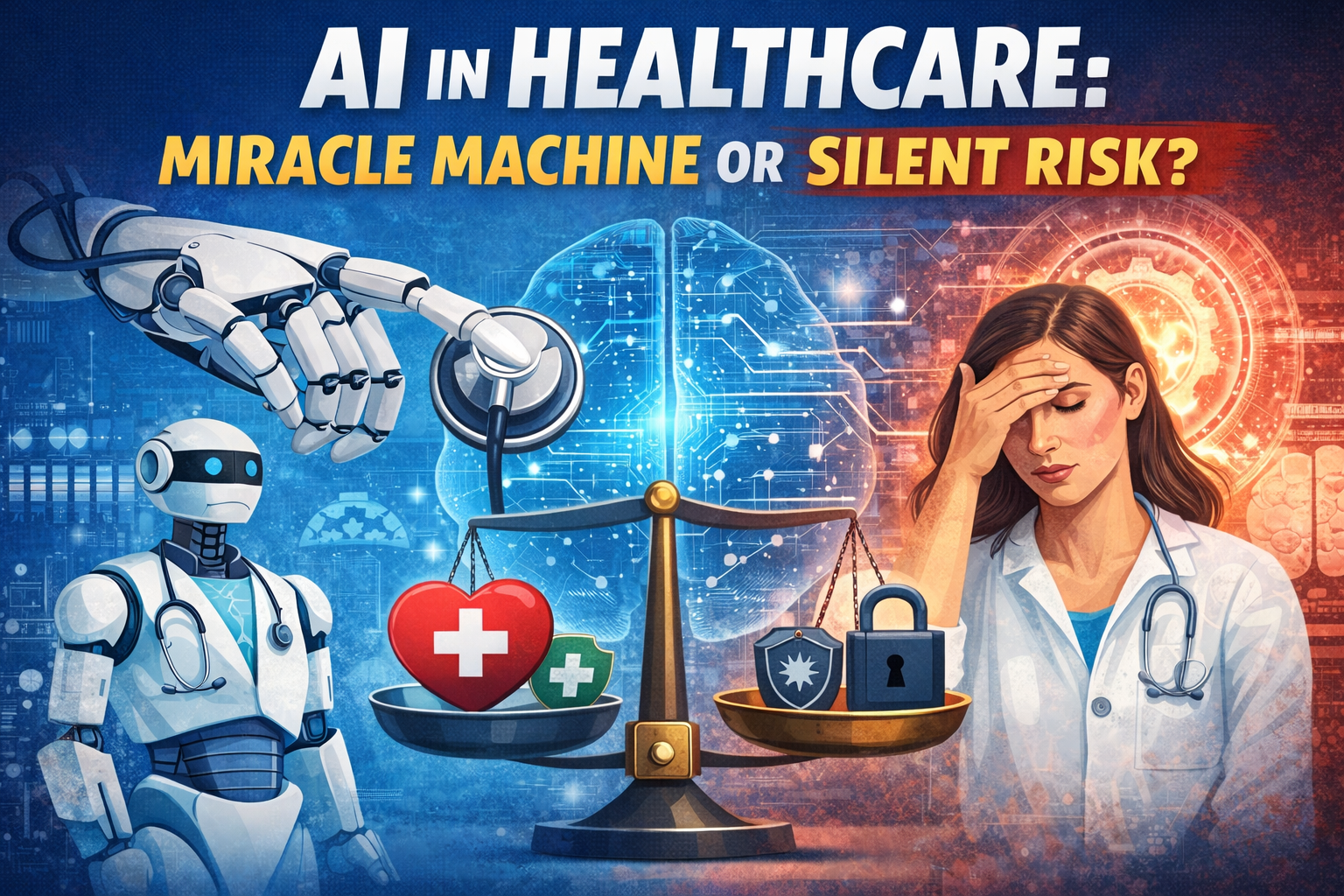
Artificial Intelligence (AI) is no longer a concept of the future. Today, AI in Healthcare is already shaping how doctors, nurses, hospitals, and patients experience medical care. From early disease detection to robot-assisted surgeries, from personalized treatment plans to predictive analytics, AI technology promises a healthcare revolution.
But along with these life-saving innovations, there are serious concerns. Issues like data privacy, algorithmic bias, over-dependence on machines, and loss of human touch in medicine raise an important question:
Is AI in Healthcare a miracle machine or a silent risk?
The truth is more complex. AI in Medicine has two sides—one that can heal faster, and another that can hurt trust if used carelessly.
Let’s explore both the promise and the peril of AI in Healthcare in simple, practical terms.
What Is AI in Healthcare?
Artificial Intelligence refers to computer systems that can analyze data, learn from patterns, and make decisions with minimal human input. In healthcare, AI systems use machine learning, deep learning, and data analytics to support medical decision-making.
Some common examples of AI in Healthcare include:
- AI-powered diagnostic tools
- Medical imaging analysis
- Predictive disease models
- Virtual health assistants and chatbots
- Robotic surgery systems
- Personalized medicine platforms
- Hospital workflow automation
In simple words, AI helps doctors work faster, smarter, and more accurately—at least in theory.
The Two Sides of AI in Health: Healing Faster or Hurting Trust?
The Healing Side: Faster, Smarter, More Accurate Care
One of the biggest advantages of AI in Healthcare is speed and accuracy.
- AI algorithms can analyze X-rays, MRIs, and CT scans faster than humans.
- Machine learning models can detect cancer, heart disease, and brain disorders at earlier stages.
- Predictive analytics can help hospitals prepare for patient surges and disease outbreaks.
- AI-driven drug discovery can reduce years of research into months.
This means faster diagnosis, earlier treatment, and better patient outcomes.
The Trust Problem: When Machines Make Mistakes
But here’s the other side: AI systems are not perfect.
- If training data is biased, the AI results will also be biased.
- If data quality is poor, predictions can be dangerously wrong.
- If doctors rely too much on AI, human judgment may be ignored.
When patients don’t understand how decisions are made, trust in healthcare can decrease. And without trust, even the best technology can fail.
Smart Tech, Real Lives: The Pros and Cons of AI in Healthcare
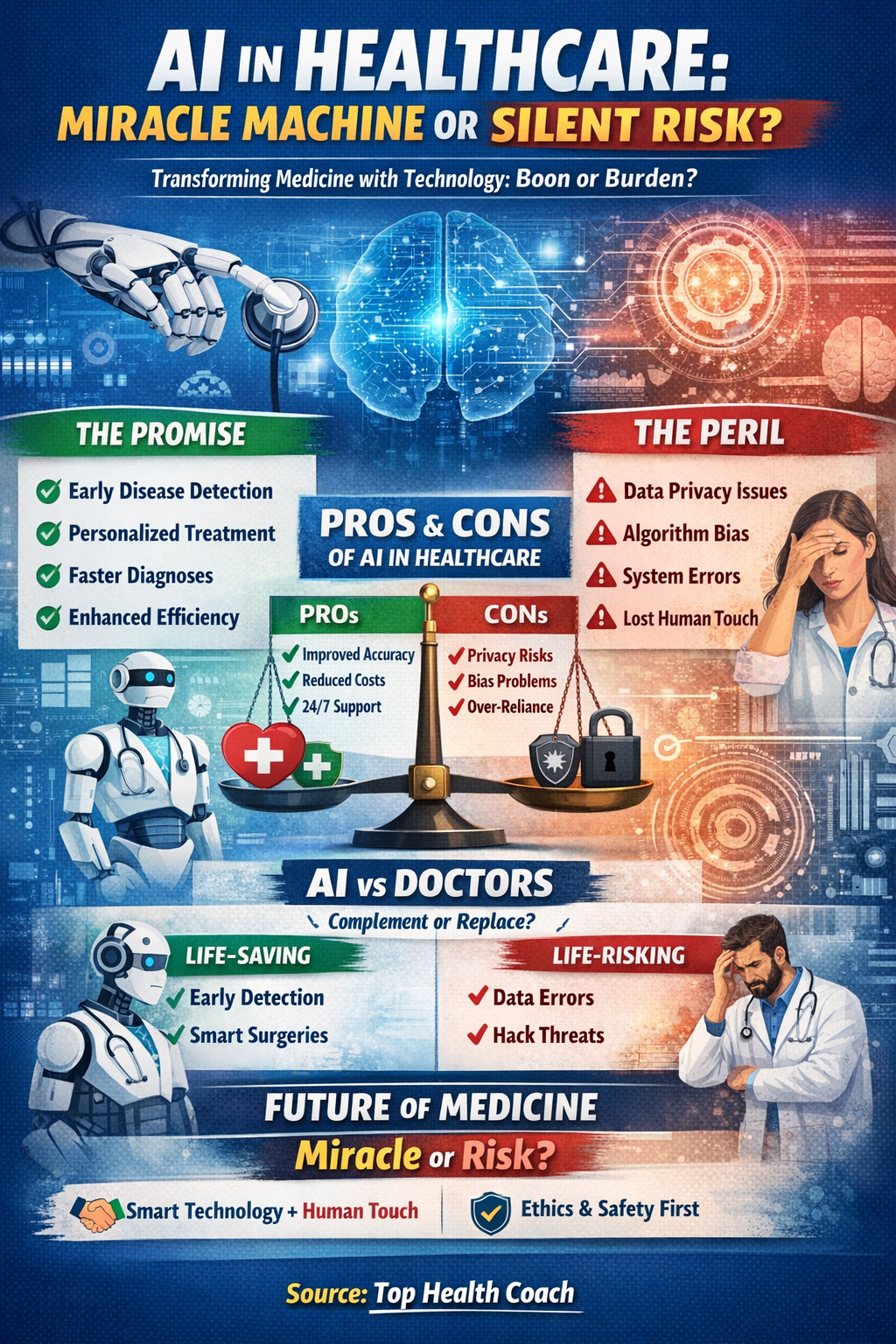
✅ Pros of AI in Healthcare
- Improved diagnostic accuracy
- Faster medical decisions
- Reduced workload for doctors and nurses
- Personalized treatment plans
- Better hospital management
- Lower long-term healthcare costs
- 24/7 virtual health support
❌ Cons of AI in Healthcare
- Data privacy risks
- Cybersecurity threats
- Algorithm bias and discrimination
- Over-reliance on technology
- Loss of human connection in care
- Job displacement fears
- High implementation costs
So yes, AI in Medicine is powerful, but it is not risk-free.
AI vs Doctors? The Bright and Dark Future of Healthcare Technology
A common fear is: Will AI replace doctors?
The realistic answer: No, but it will change their role.
The Bright Future
- AI tools can handle routine tasks like report analysis and data entry.
- Doctors can spend more time with patients.
- Clinical decisions can be better informed by data-driven insights.
- Surgical robots can improve precision and safety.
The Dark Side
- Some healthcare systems may over-trust AI.
- Junior doctors may lose critical thinking skills if they rely too much on machines.
- Patients may feel like they are being treated by systems, not humans.
The future should be AI + Doctors, not AI vs Doctors.
From Life-Saving to Life-Risking: The Truth About AI in Health
AI systems can save lives, but they can also put lives at risk if used without proper checks.
Life-Saving Examples
- Early cancer detection using AI imaging tools
- Stroke prediction using real-time data analysis
- ICU monitoring systems that detect critical changes instantly
- Drug interaction alerts that prevent medical errors
Life-Risking Scenarios
- Wrong diagnosis due to biased data
- Software errors in medical devices
- Hacked hospital systems causing treatment delays
- Blind trust in AI recommendations without human review
This is why human oversight is non-negotiable in AI-driven healthcare.
Can AI Make Us Healthier—or Just More Dependent?
There is no doubt that AI health apps, fitness trackers, and symptom checkers are making people more aware of their health.
But there’s a hidden risk: digital dependence.
- People may self-diagnose using AI tools instead of seeing a doctor.
- Some may panic over incorrect predictions.
- Others may ignore symptoms because an app says everything is fine.
AI should support healthy behavior, not replace medical responsibility.
AI in Medicine: Breakthroughs, Bias, and Big Questions
Breakthroughs
- Personalized medicine based on genetic data
- Faster clinical trials using AI data models
- Better treatment matching for chronic diseases
- Remote patient monitoring with smart devices
Bias
- If training data mainly comes from one population, AI results may be unfair to others.
- This can lead to unequal treatment, especially for minority groups and underrepresented communities.
Big Questions
- Who is responsible if AI makes a wrong decision?
- How do we protect patient data?
- How much control should machines have in medical decisions?
- How do we keep healthcare human in a digital world?
The Promise and the Peril: How AI Is Changing Healthcare
The Promise
- Better access to healthcare in remote areas
- Lower costs through automation
- More accurate diagnoses
- Faster treatment plans
- Smarter public health systems
The Peril
- Privacy violations
- Ethical dilemmas
- System failures
- Loss of empathy in care
- Digital inequality between rich and poor regions
AI in Healthcare is like a powerful medicine:
In the right dose, it heals.
In the wrong dose, it harms.
Robots, Data, and Doctors: The Good and Bad of AI in Health
The Good
- Robotic surgery improves precision
- Big data analysis improves medical research
- Automation reduces human errors
- AI assistants reduce doctor burnout
The Bad
- High costs limit access for small hospitals
- Technical failures can disrupt critical care
- Over-standardization can ignore individual patient needs
- Reduced human interaction can affect patient satisfaction
Future of Healthcare or Tech Trap? The Real Impact of AI on Health
The future of AI in Healthcare depends on how we use it.
If we use AI responsibly, with:
- Strong regulations
- Ethical guidelines
- Human oversight
- Data protection laws
- Transparent systems
Then AI can truly become a miracle machine.
But if we use it carelessly, without:
- Proper testing
- Bias checks
- Security systems
- Human control
Then AI can become a silent risk.
Final Verdict: Miracle Machine or Silent Risk?
AI in Healthcare is both.
It is a miracle machine when it:
- Supports doctors
- Improves accuracy
- Saves time and lives
- Expands access to care
It becomes a silent risk when it:
- Replaces human judgment
- Ignores ethics
- Misuses patient data
- Creates blind dependence on technology
The real solution is balance:
Smart technology + Human compassion = Better healthcare.
FAQ: AI in Healthcare – Miracle Machine or Silent Risk?
1. Is AI in Healthcare really useful?
Yes, AI in Healthcare is very useful for diagnosis, treatment planning, medical imaging, and hospital management, but it must be used with human supervision.
2. Can AI replace doctors?
No. AI cannot replace doctors, but it can assist doctors by handling data analysis and routine tasks.
3. What are the main risks of AI in Healthcare?
The main risks include data privacy issues, algorithm bias, system errors, cybersecurity threats, and over-reliance on technology.
4. Is AI in Medicine safe?
AI in Medicine can be safe if it is properly tested, regulated, and used with human oversight.
5. How does AI improve patient care?
AI improves patient care by enabling faster diagnosis, personalized treatment, early disease detection, and better monitoring.
6. What is algorithm bias in healthcare AI?
Algorithm bias happens when AI systems are trained on unbalanced data, leading to unfair or inaccurate results for some groups.
7. Can AI reduce healthcare costs?
Yes, AI can reduce healthcare costs by automating processes, reducing errors, and improving efficiency, but initial setup costs can be high.
8. Will AI make patients too dependent on technology?
There is a risk of digital dependence, which is why AI tools should support—not replace—medical advice.
9. What is the future of AI in Healthcare?
The future includes smarter diagnostics, personalized medicine, remote monitoring, and AI-assisted surgeries, with strong ethical rules.
10. Is AI in Healthcare a miracle or a risk?
It is both—a miracle machine when used wisely, and a silent risk when used without ethics, safety, and human control.