Calf Exercises – Training at Home and at the Gym | Top Health Coach
Strong calves are important for walking, running, climbing stairs, jumping, and maintaining balance. Whether you want stronger calf muscles, improved athletic performance, or better lower-leg strength, the right calf exercises can help you work toward your fitness goals at home or at the gym.
The good news is that you do not need expensive equipment to begin. Simple calf raises at home, bodyweight exercises, and gentle stretching can help beginners build a foundation. At the gym, resistance machines and weights can provide additional challenges as your strength improves.
In this guide, you will learn the best calf exercises for beginners, how to train your calves at home and in the gym, how often to exercise, and how to progress safely.
What Are Calf Muscles and Why Are They Important?
Your calves are the muscles located at the back of your lower legs. Two major muscles make up most of this area:
- Gastrocnemius: The larger, visible calf muscle that contributes to the shape of your lower legs. It works when you point your toes and push off the ground.
- Soleus: A deeper calf muscle that plays an important role in ankle movement and supporting your body during standing and walking.
Together, these muscles help you perform everyday activities such as walking, running, jumping, and climbing stairs.
Regular calf muscle exercises can improve muscular strength and endurance. They can also complement balance training and other lower-body workouts.
Benefits of Calf Exercises for Stronger Legs
Adding calf strengthening exercises to your fitness routine can provide several benefits.
1. Build Stronger Calf Muscles
Consistent resistance training challenges the calf muscles and can help increase their strength and size over time. Gradually increasing repetitions or resistance makes your workouts more challenging.
2. Support Walking and Running
Your calf muscles contribute to pushing your body forward during walking and running. Developing calf strength can help support these movements, although performance also depends on your overall fitness and technique.
3. Improve Ankle Strength and Mobility
The calf muscles work with the ankle joint during everyday movements. Combining strengthening exercises with suitable stretches can help maintain lower-leg function and flexibility.
4. Support Balance and Stability
Strong lower-leg muscles contribute to standing and moving with control. Pair calf training with other leg-strengthening and balance exercises for a more complete fitness routine.
5. Support Sports Performance
Runners, football players, basketball players, and other athletes regularly use their calf muscles. Training these muscles can complement sport-specific conditioning.
For general guidance on strength training, visit the NHS strength exercises guide.
Best Calf Exercises at Home Without Equipment
You can begin calf training at home with little or no equipment. Choose a stable surface and use a sturdy chair or wall for balance when necessary.
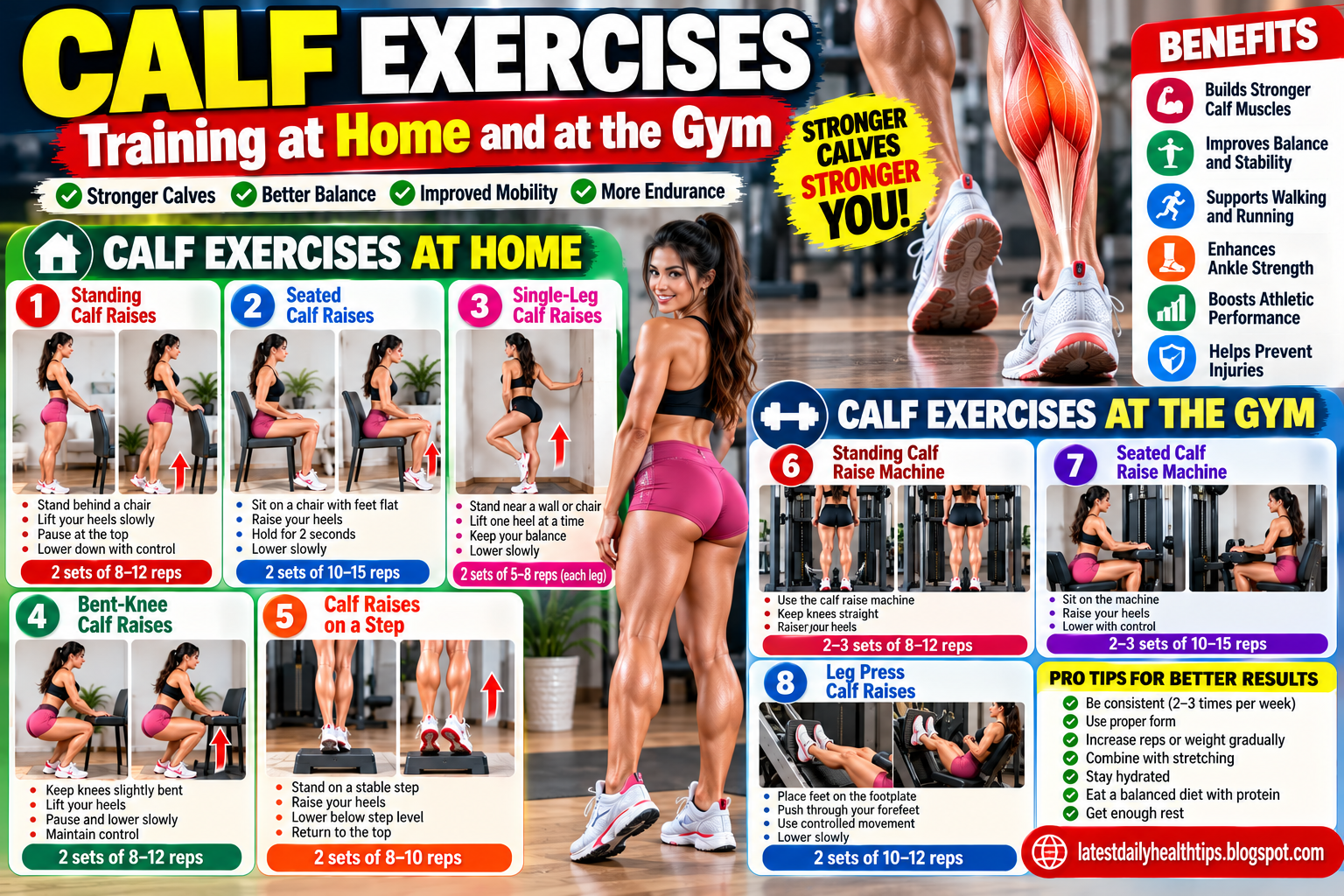
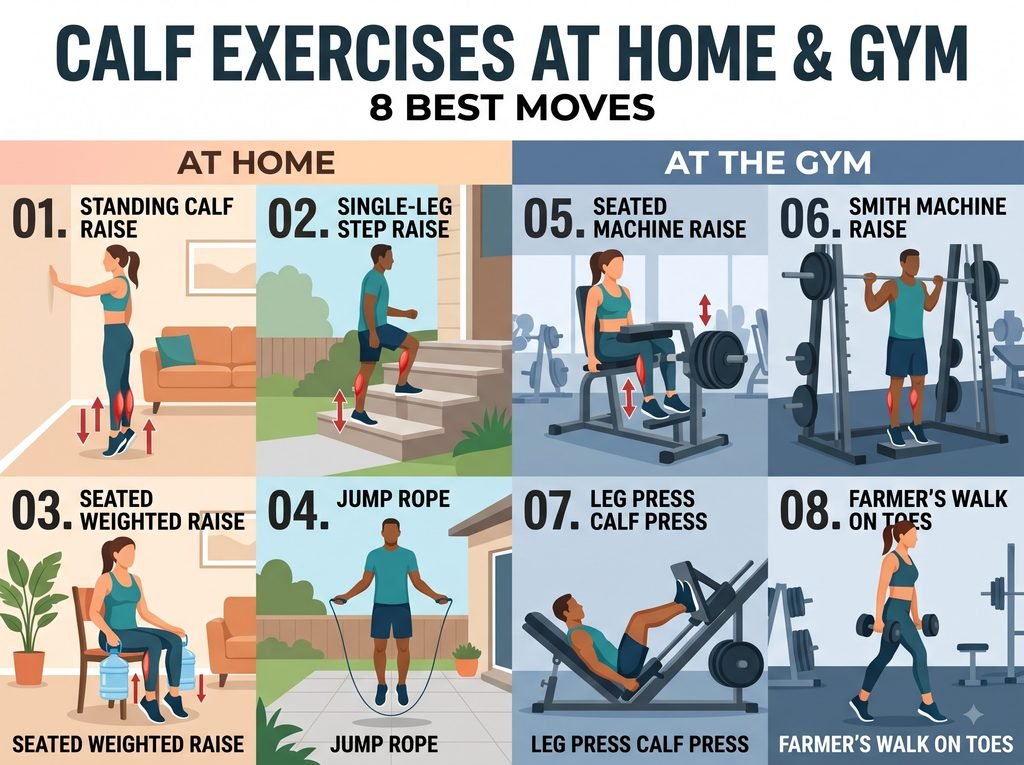
1. Standing Calf Raises
Standing calf raises are among the best beginner-friendly calf exercises at home. They target the calf muscles using your body weight.
How to do standing calf raises:
- Stand upright with your feet approximately hip-width apart.
- Hold a sturdy chair or wall for balance if needed.
- Slowly raise both heels until you are standing on the balls of your feet.
- Pause briefly at the top.
- Lower your heels slowly to the floor.
Recommended starting point: 2 sets of 8–12 repetitions.
Tip: Avoid bouncing. Use a controlled movement and keep your weight balanced over your feet.
2. Seated Calf Raises
Seated calf raises are useful for beginners and people who find standing exercises uncomfortable. They also allow you to emphasize the soleus muscle.
How to do seated calf raises:
- Sit on a sturdy chair with your feet flat on the floor.
- Keep your knees bent and your back comfortably upright.
- Lift your heels while keeping the balls of your feet on the floor.
- Pause briefly.
- Lower your heels slowly.
Recommended starting point: 2 sets of 10–15 repetitions.
Once the movement becomes easier, you may add light resistance across your thighs, provided you can do so safely.
3. Single-Leg Calf Raises
Single-leg calf raises increase the challenge by making one calf support more of your body weight.
How to perform single-leg calf raises:
- Stand near a wall or sturdy chair.
- Shift your weight onto one foot.
- Lift the opposite foot slightly off the floor.
- Raise the heel of your supporting foot.
- Lower slowly and complete your repetitions.
- Repeat on the other leg.
Recommended starting point: 1–2 sets of 5–8 repetitions per leg.
Start with both feet on the floor if you struggle with balance. Progress gradually rather than forcing extra repetitions.
4. Calf Raises on a Step
Calf raises on a step can increase the range of motion when performed correctly. This variation is better suited to people who already have good balance and can control the movement.
How to do step calf raises:
- Stand on a stable, nonslip step while holding a secure handrail.
- Position the balls of your feet on the step, with your heels near the edge.
- Raise your heels as high as comfortable.
- Lower them slowly without forcing a deep stretch.
- Repeat while maintaining your balance.
Recommended starting point: 2 sets of 8–10 repetitions.
Do not use an unstable chair or stool. Beginners should start on a flat floor.
5. Bent-Knee Calf Raises
Bent-knee calf raises place greater emphasis on the soleus muscle than straight-knee variations.
How to perform bent-knee calf raises:
- Stand with your feet hip-width apart.
- Bend your knees slightly while keeping your torso upright.
- Raise your heels slowly.
- Pause at the top.
- Lower your heels under control.
Recommended starting point: 2 sets of 8–12 repetitions.
Keep the knee bend comfortable and avoid turning the exercise into a squat.
Best Calf Exercises at the Gym
If you have access to a gym, you can use machines and weights to progressively challenge your calf muscles.
6. Standing Calf Raise Machine
The standing calf raise machine provides resistance while you work your calves with relatively straight knees.
How to use the machine:
- Adjust the machine according to its instructions.
- Position the balls of your feet on the designated platform.
- Keep your knees straight but not forcefully locked.
- Raise your heels as high as you can comfortably manage.
- Pause briefly and lower slowly.
Recommended starting point: 2–3 sets of 8–12 repetitions.
Choose a weight that allows you to maintain good technique throughout every repetition.
7. Seated Calf Raise Machine
The seated calf raise machine is another useful gym exercise, especially for targeting the soleus muscle.
How to perform seated machine calf raises:
- Sit comfortably and position your feet on the platform.
- Place your knees beneath the machine’s padded support.
- Release the safety mechanism according to the machine instructions.
- Lift your heels while keeping your toes on the platform.
- Lower the weight slowly and repeat.
Recommended starting point: 2–3 sets of 10–15 repetitions.
If the machine feels uncomfortable around your knees or ankles, stop and check your setup before continuing.
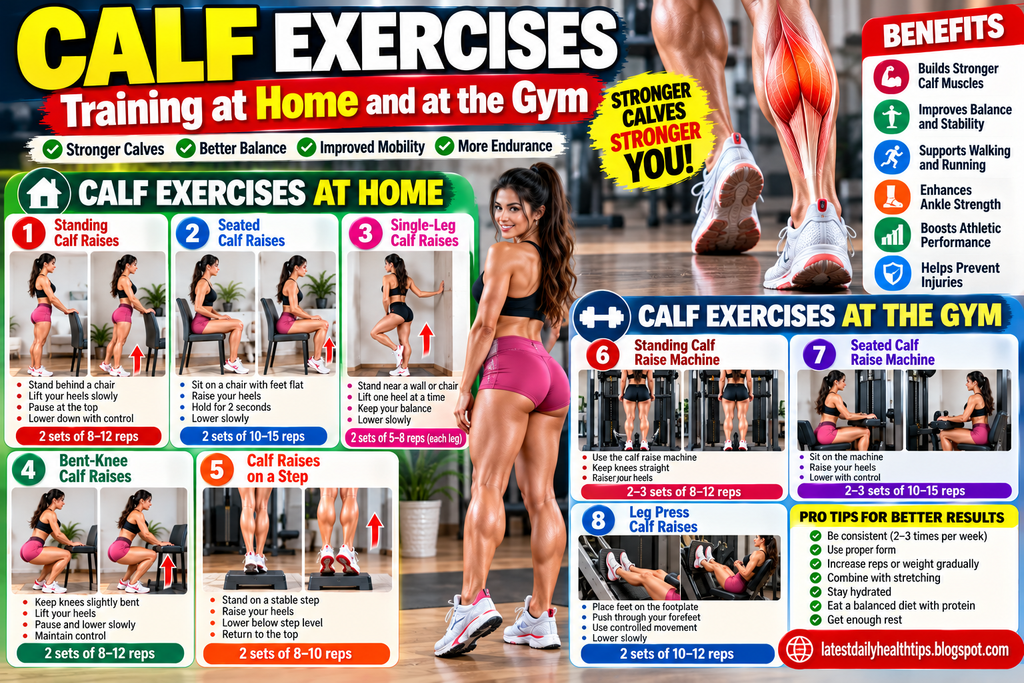
8. Leg Press Calf Raises
Leg press calf raises allow you to train your calves using a leg press machine. Correct positioning is particularly important because the machine uses external resistance.
How to do leg press calf raises:
- Set up the leg press according to the manufacturer’s instructions.
- Position the balls of your feet securely on the footplate.
- Keep the knees slightly bent rather than forcefully locking them.
- Move your ankles to push the platform away through your forefeet.
- Return slowly to the starting position.
Recommended starting point: 2 sets of 10–12 repetitions with light resistance.
Keep your feet securely positioned throughout the exercise. Do not allow them to slip toward the edge of the platform.
How Often Should You Train Your Calves?
The best calf workout routine depends on your experience, training schedule, recovery, and goals.
Beginners can start with two calf workouts per week, allowing recovery between challenging sessions. If your calves are already heavily involved in running, jumping, or other sports, adjust your training accordingly.
A simple routine could include:
- Standing calf raises: 2 sets of 10–12 repetitions
- Seated calf raises: 2 sets of 12–15 repetitions
- Bent-knee calf raises: 2 sets of 8–12 repetitions
- Gentle calf stretches: 2–3 holds of 20–30 seconds per side
You do not need to perform every exercise in one session. Choose two or three suitable movements and focus on quality.
For broader guidance on exercise frequency and resistance training, see the CDC’s physical activity recommendations.
Tips for Better Calf Muscle Growth
If your goal is calf muscle growth, consistency and progressive training matter more than doing hundreds of repetitions.
- Use a full, comfortable range of motion: Lift your heels high and lower them under control without forcing your ankles into painful positions.
- Increase resistance gradually: Add repetitions or a small amount of weight when your current routine becomes manageable.
- Maintain proper form: Avoid swinging your body or bouncing at the bottom of each repetition.
- Train both legs: Work each side evenly and use single-leg variations only when you can maintain balance.
- Allow time for recovery: Rest between demanding workouts and avoid training through significant pain.
- Eat a balanced diet: Include sufficient protein and a variety of nutrient-rich foods to support muscle repair.
- Get enough sleep: Regular, adequate sleep supports recovery and overall exercise performance.
Remember that stronger calf muscles develop over time. Genetics, training history, nutrition, and consistency all influence muscle size and shape.
Common Calf Training Mistakes to Avoid
Avoid these common mistakes when performing calf exercises at home or at the gym:
- Using too much weight: Excessive resistance can make it difficult to control the movement.
- Doing partial repetitions: Repeatedly using a very small range of motion may limit the training stimulus.
- Bouncing through repetitions: Use controlled movements instead of relying on momentum.
- Ignoring recovery: Constant hard training without adequate recovery may reduce workout quality.
- Skipping warm-ups: Begin with a few minutes of easy movement and gentle ankle movements.
- Ignoring pain: Stop if an exercise causes sharp pain, sudden weakness, or worsening symptoms.
If you have a recent calf injury, ankle surgery, or a diagnosed muscle or joint condition, seek guidance from a healthcare professional before starting a new program. The NHS Inform calf and ankle exercise guide provides additional advice on adapting exercises.
Frequently Asked Questions About Calf Exercises
1. What are the best calf exercises for beginners?
Standing calf raises, seated calf raises, and gentle calf stretches are good starting options. Begin with body weight exercises and use a stable chair or wall for support.
2. Can I build stronger calves at home?
Yes. Calf exercises at home can improve strength when performed consistently and progressed gradually. Bodyweight exercises may be sufficient for beginners, while stronger exercisers may need additional resistance.
3. How many calf raises should I do daily?
There is no single ideal daily number for everyone. Start with 1–2 sets of 8–12 repetitions per session, two or more times per week as tolerated, and adjust according to your recovery and fitness level.
4. Are standing or seated calf raises better?
Both are useful. Standing calf raises emphasize the gastrocnemius more, while seated calf raises place greater emphasis on the soleus. Including both can help train the calf muscles from different positions.
5. How long does it take to build calf muscles?
Progress varies depending on genetics, exercise experience, nutrition, resistance, and consistency. You may notice improvements in exercise performance within several weeks, while visible muscle growth often takes longer.
6. Do calf exercises help with walking and running?
Calf training strengthens muscles involved in pushing off the ground during walking and running. However, running performance also depends on cardiovascular fitness, technique, and strength throughout the body.
7. Can I train my calves every day?
Light activity may be suitable daily, but challenging resistance workouts do not necessarily need to be performed every day. Allow recovery between demanding sessions, especially if you experience soreness.
8. Which gym machine is best for calf muscles?
The standing calf raise machine and seated calf raise machine are both useful. The standing machine emphasizes the gastrocnemius, while the seated version emphasizes the soleus. Choose the machine that fits your goals and allows comfortable, controlled movement.
9. Do calf stretches make calf muscles stronger?
Calf stretches primarily target flexibility and range of motion rather than directly building muscle strength. Combine appropriate stretching with resistance exercises for a more complete lower-leg routine.
10. Should I exercise if my calves hurt?
Mild muscle soreness after a new workout can occur, but sharp, severe, or worsening pain should not be ignored. Stop the exercise if pain develops. Sudden one-sided calf swelling, warmth, redness, or unexplained pain needs urgent medical assessment because it can indicate a blood clot. Seek emergency help for chest pain or difficulty breathing.
Final Thoughts
The best calf exercises are the ones you can perform safely, consistently, and with good technique. Start with standing calf raises, seated calf raises, and other simple movements at home. As your strength improves, consider adding a standing calf raise machine, seated calf raise machine, or other suitable resistance exercises at the gym.
Focus on gradual progress, balanced nutrition, and adequate recovery instead of chasing quick results. Strong calves are one part of a complete fitness routine that also includes the thighs, hips, core, and upper body.
For more practical fitness tips and Latest Health News, visit Top Health Coach and explore Latest Daily Health Tips.
Medical disclaimer: This article is for general educational purposes and is not a substitute for individualized medical advice. Consult a qualified healthcare professional before beginning a new exercise program if you have an injury, ongoing pain, or a medical condition.